Thursday, July 15, 2010

Set 345

For first time visitors I recommend this archive for some of my best posts.


1981. Approximately 17" tall, take a look at Neatorama for more guesses on this device and a chance to win a prize:


1982. 14" long:

Larger image


1983. The large opening is around 12" wide:

Larger image


1984. 18" long, sent in by a visitor who is looking to find the purpose of this trough:


1985. 18" long:

Larger image
Photos by Christopher Young


1986. 4" diameter:

Larger image


Answers:


1981. A British Absolute Block Signaling Instrument, used to "facilitate the safe operation of a railway by preventing more than one train from occupying a defined section of route at the same time. This system is used on double or multiple lines where use of each line is assigned a direction of travel." The Millom Station is in the town of Millom in Cumbria, England.


1982. A tool for opening wood crates, text on it reads "Mellor box opener No. 1", the patent states that it's a combination tool that could also be used for opening barrels, stretching wires, and driving and removing staples in constructing or repairing wire fences, patent number RE12458.

Larger image


1983. An X-ring Products Centrifugal Bullet Trap, a target was placed in front of the large opening, the bullets would be funneled to the back where they would be slowed down and then drop out.

Larger image


According to the seller it will take up to 45 cal. using target loads, behind the small plate at the top there is a metal clip for holding a paper target.


Patent number 4,126,311

Larger image


1984. No verifiable answer for this one yet:


1985. "The Springfield" tire tool, text on it says "For tires 3 to 5 in":

Larger image
Photos by Christopher Young


1986. A U.S. Signal Corps Cipher Disk, it was used during the Civil War at the Gettysburg Campaign, and was developed by Albert J. Myer, Chief Signal Officer of The Army of the Potomac. The disk was used to decode messages sent via signal flags. The hand written number 32 is a control number, used for accountability of the disk. Patent number 50,946

Larger image


The cipher disk pictured above was used by the Union, the one below is a replica of a Confederate cipher disk, which was for sale at the museum.


To submit photos, send them to the address in my profile.


Last week's set is seen below, click here to view the entire post.


More discussion and comments on these photos can be found at the newsgroup rec.puzzles.

Thursday, July 8, 2010

Set 344

For first time visitors I recommend this archive for some of my best posts.


1975. 2-3/4" long, this piece of metal is an important tool for a well known trade:


1976. The red part is 5-1/2" long:


1977. 5-3/4" long, submitted by a visitor who is looking to identify this piece of hardware, text on says 'Patent Pending':


1978. The bowls in the rack each have a hole in the center:


1979. 1" long, take a look at Neatorama for more guesses and a chance to win a T-shirt:


1980. 19" tall, another unidentified item that was sent in by a visitor:


Answers:


1975. A locksmith's tension wrench or torsion wrench, used to apply torsion to the inner cylinder of a lock, in order to hold any picked pins in place, while the other pins are shifted. The torsion wrench is then used to turn the inner cylinder and open the lock.


1976. The core of a bowling ball:


1977. No answer yet for this item:


1978. A water clock, there are many different types of water clocks, this one measures the amount of time it takes the bowls to sink into the water.


1979. From the National Civil War Museum in Harrisburg, PA, text at this display reads:
Pain Bullets
Frequently called "hospital bullets," these lead bullets were given to patients in anticipation of pain during surgery. "Bite the bullet" soon became a common expression. These bullets, complete with teeth marks, were found near a hospital site after the Battle of Gettysburg.
Although some people think "biting a bullet" is pure Hollywood and TV mythology.


1980. No luck so far in finding the purpose of this clamp:


To submit photos, send them to the address in my profile.


Last week's set is seen below, click here to view the entire post.


More discussion and comments on these photos can be found at the newsgroup rec.puzzles.

Thursday, July 1, 2010

Set 343

For first time visitors I recommend this archive for some of my best posts.


1969. Around 3" diameter:


1970. About 42" long:

Photo by Christopher Young


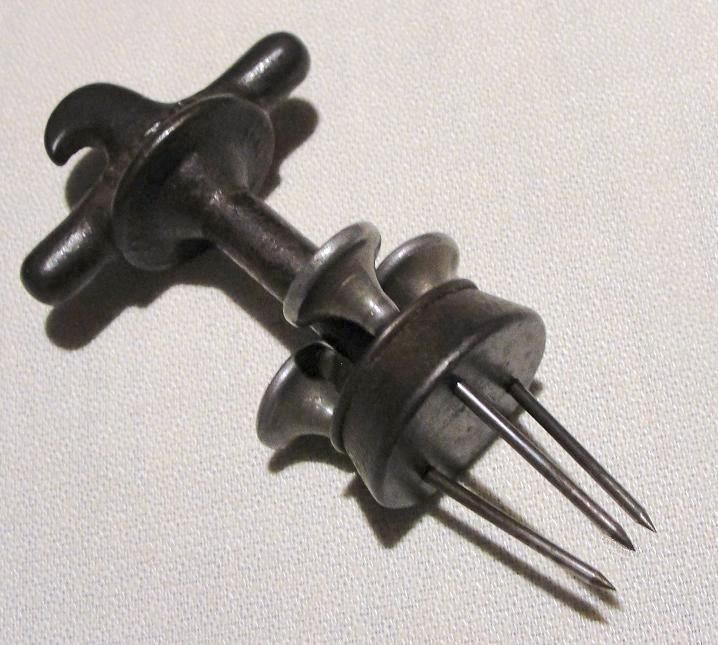
1971. Approximately 2-1/2" long in this first photo, take a look at Neatorama for more guesses and a chance to win a prize:

From Bob Roger's collection


Larger image


1972. 8" long:


1973. 6" tall, from the 1860s:


1974. 7' tall, this gauge was sent in by a visitor who is looking to find its exact purpose:


Answers:


1969. A football official's chain yard marker, it was attached to the first down measuring chain so it could be reset to its proper location if the chain was moved. In this photo, the marker would have been placed at either the 15 or 20 yard line.


1970. A bark spud, it was used to remove bark from a tree trunk, but first the bark was cut in two places around the circumference of the tree and then it was slit lengthwise between the two cuts with a hatchet. The bark spud was then used like a chisel to separate the bark from the wood.

Photo by Christopher Young


1971. A cork remover, patent number 1,213,452, which states:
By then imparting a gradual rotating movement of the bottle with respect to the extractor, or of the extractor with respect to the bottle, the stopper will be moved in a circular direction in the bottle neck and such rotation will readily free the stopper as the tendency of the latter is to move outwardly during such rotation.


From Bob Roger's collection


Larger image


1972. A hollow auger, also called a spoke auger or tenon cutter, it's a bit brace tool used to cut a round tenon such as required on a wagon spoke or chair rung.


1973. A Civil War soldier's shaving mug, the rectangular compartment was for holding a shaving brush or razor.


1974. No answer yet for this one, possibly a some type of pressure or cistern gauge:


To submit photos, send them to the address in my profile.


Last week's set is seen below, click here to view the entire post.


More discussion and comments on these photos can be found at the newsgroup rec.puzzles.