Thursday, July 8, 2010

Set 344

For first time visitors I recommend this archive for some of my best posts.


1975. 2-3/4" long, this piece of metal is an important tool for a well known trade:


1976. The red part is 5-1/2" long:


1977. 5-3/4" long, submitted by a visitor who is looking to identify this piece of hardware, text on says 'Patent Pending':


1978. The bowls in the rack each have a hole in the center:


1979. 1" long, take a look at Neatorama for more guesses and a chance to win a T-shirt:


1980. 19" tall, another unidentified item that was sent in by a visitor:


Answers:


1975. A locksmith's tension wrench or torsion wrench, used to apply torsion to the inner cylinder of a lock, in order to hold any picked pins in place, while the other pins are shifted. The torsion wrench is then used to turn the inner cylinder and open the lock.


1976. The core of a bowling ball:


1977. No answer yet for this item:


1978. A water clock, there are many different types of water clocks, this one measures the amount of time it takes the bowls to sink into the water.


1979. From the National Civil War Museum in Harrisburg, PA, text at this display reads:
Pain Bullets
Frequently called "hospital bullets," these lead bullets were given to patients in anticipation of pain during surgery. "Bite the bullet" soon became a common expression. These bullets, complete with teeth marks, were found near a hospital site after the Battle of Gettysburg.
Although some people think "biting a bullet" is pure Hollywood and TV mythology.


1980. No luck so far in finding the purpose of this clamp:


To submit photos, send them to the address in my profile.


Last week's set is seen below, click here to view the entire post.


More discussion and comments on these photos can be found at the newsgroup rec.puzzles.

Thursday, July 1, 2010

Set 343

For first time visitors I recommend this archive for some of my best posts.


1969. Around 3" diameter:


1970. About 42" long:

Photo by Christopher Young


1971. Approximately 2-1/2" long in this first photo, take a look at Neatorama for more guesses and a chance to win a prize:

From Bob Roger's collection


Larger image


1972. 8" long:


1973. 6" tall, from the 1860s:


1974. 7' tall, this gauge was sent in by a visitor who is looking to find its exact purpose:


Answers:


1969. A football official's chain yard marker, it was attached to the first down measuring chain so it could be reset to its proper location if the chain was moved. In this photo, the marker would have been placed at either the 15 or 20 yard line.


1970. A bark spud, it was used to remove bark from a tree trunk, but first the bark was cut in two places around the circumference of the tree and then it was slit lengthwise between the two cuts with a hatchet. The bark spud was then used like a chisel to separate the bark from the wood.

Photo by Christopher Young


1971. A cork remover, patent number 1,213,452, which states:
By then imparting a gradual rotating movement of the bottle with respect to the extractor, or of the extractor with respect to the bottle, the stopper will be moved in a circular direction in the bottle neck and such rotation will readily free the stopper as the tendency of the latter is to move outwardly during such rotation.


From Bob Roger's collection


Larger image


1972. A hollow auger, also called a spoke auger or tenon cutter, it's a bit brace tool used to cut a round tenon such as required on a wagon spoke or chair rung.


1973. A Civil War soldier's shaving mug, the rectangular compartment was for holding a shaving brush or razor.


1974. No answer yet for this one, possibly a some type of pressure or cistern gauge:


To submit photos, send them to the address in my profile.


Last week's set is seen below, click here to view the entire post.


More discussion and comments on these photos can be found at the newsgroup rec.puzzles.

Thursday, June 24, 2010

Set 342

For first time visitors I recommend this archive for some of my best posts.


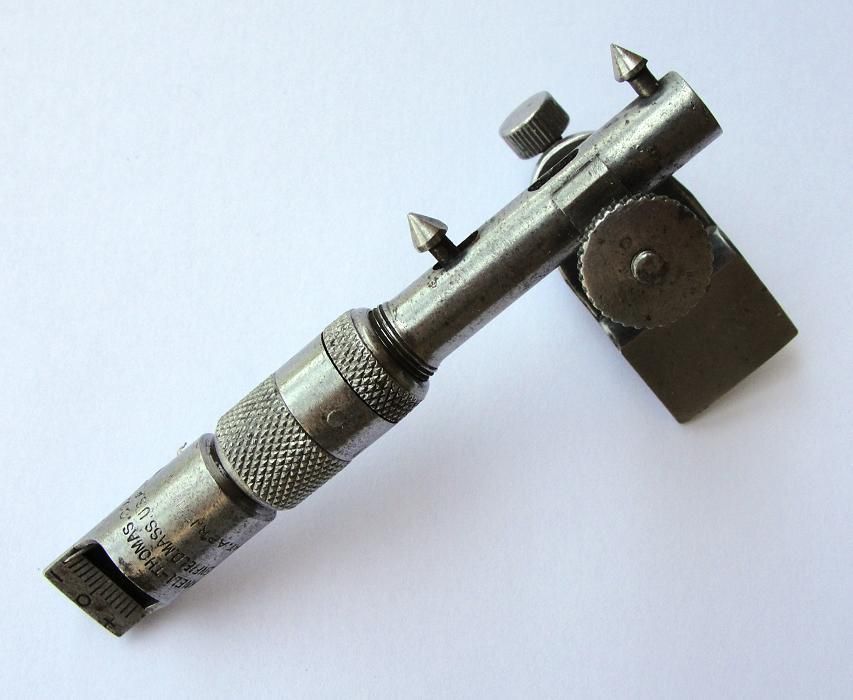
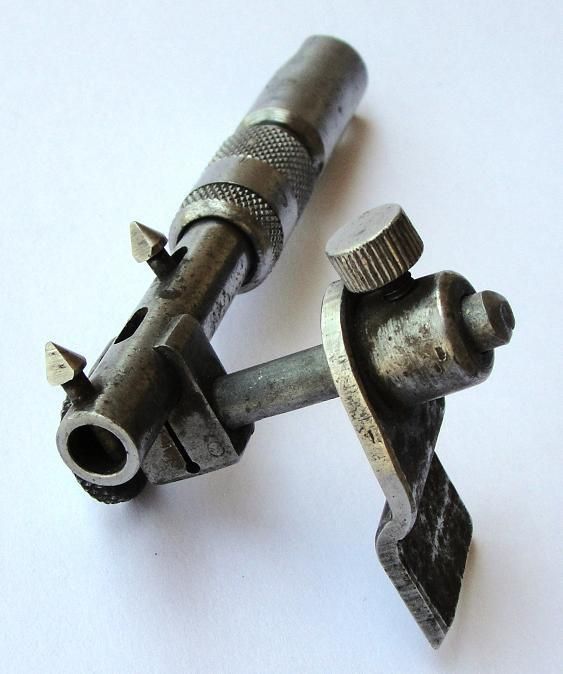
1963. 3-3/4" long:

Larger image


Larger image


1964. Approximately 24" tall:


1965. Sent in by a visitor who is looking to find the purpose of this tool:


1966. Another unidentified item that was sent in by a visitor, the 18" rods are made of solid stainless steel except for the red one which is plastic:


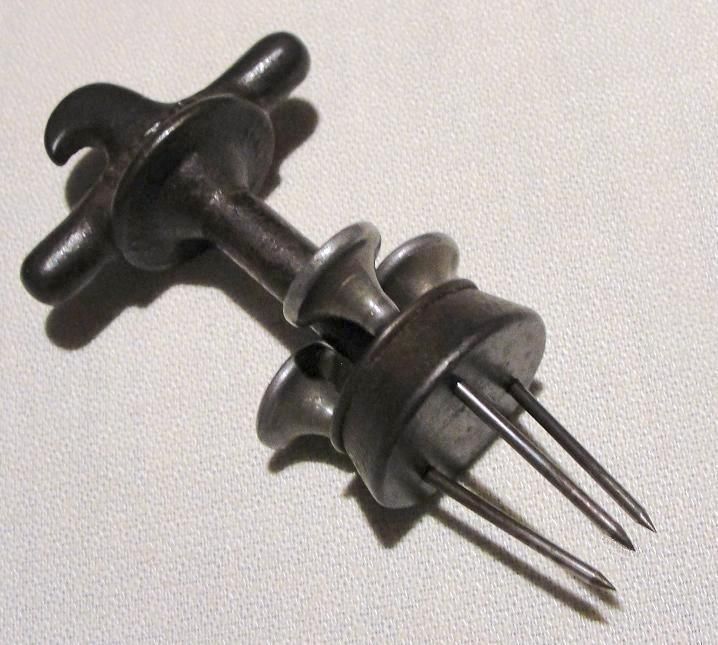
1967. About 3" diameter, take a look at Neatorama for more guesses on this one and a chance to win a prize:

From Bob Roger's collection


1968. Around 17" tall, this is step one in the making of a particular product:


Answers:


1963. A "Screw Thread Gaging Device", patent number 1,223,012:
...for gaging and testing the pitch or "lead" of screw threaded parts...for determining whether the threads on an article, as for instance a tap, die or other threaded piece, and designed to be of a certain number to an inch are truly formed as per the requirement, or at variance therefrom to an appreciable extent.


Larger image


Larger image


Text on it reads:
Bicknell-Thomas Co.
Greenfield, Mass. U.S.A.
Pat. Apr. 17, 1917


1964. A protective cover for a fire hydrant, it's marked:
Birkinbine's
Patent
Aug. 8, 1876


Patent number 180,830 was issued to Birkinbine on that date but it's for a fire hydrant, not for a protective cover.


The top of it states:
10 dollar fine for interfering with this plug
Manufactured by Variety Iron Works, York, Penn


1965. Probably a woodworker's router or scraper for use by a coachmaker:


1966. A listening device for finding defects in machines, motors, dynamos, or turbines, the instructions state:
...fix the end of the device (when needed mount the extension pieces together) on the external part of the examined surface such as a cylinder, gearbox, carb, differential, mechanical parts, pipes and so on. Put the membrane to your ear and diagnose by simply listening; defects such as oil deficiency, loose bolts, screws and so on with certainty. In danger of electrocution use the red insulated sound finder that neutralizes electricity. When checking for pipe defects hold the device to the raised examinated part such as hydrants and so on. It will work even through brick walls, bitumen and soil to diagnose the defect.


1967. An ice cube crusher, the patent states:
...it is proposed to arrange the containers telescopically relative to each other and to provide a plurality of pointed elements mounted on the top and base wall of the containers and directed towards each other for cracking a piece of ice placed within the containers when they are forced together.

Patent number 2,147,394


From Bob Roger's collection


1968. A billet, an early stage of a bowling pin, it is "inserted into a lathe with a large blade in the shape of the bowling pin. The knife blade is pressed into the rotating piece of wood stock and the entire bowling pin is cut in one pass by the shaping knife blade."


To submit photos, send them to the address in my profile.


Last week's set is seen below, click here to view the entire post.


More discussion and comments on these photos can be found at the newsgroup rec.puzzles.